John Ruthven, master wildlife artist, naturalist, philanthropist, dead at 95

CINCINNATI (FOX19) -John A. Ruthven, internationally celebrated master wildlife artist, naturalist, author, and lecturer, died Sunday. He was 95.
Our media partners at the Cincinnati Enquirer says he often was called the “20th Century Audubon,” Ruthven used many of the same techniques as the famed John James Audubon, the American ornithologist, artist and naturalist of the late 18th and early 19th Centuries.
Ruthven never doubted he would be an artist. “I continually took my sketch pad with me wherever I went” as a young boy, he said in an entry on his website.
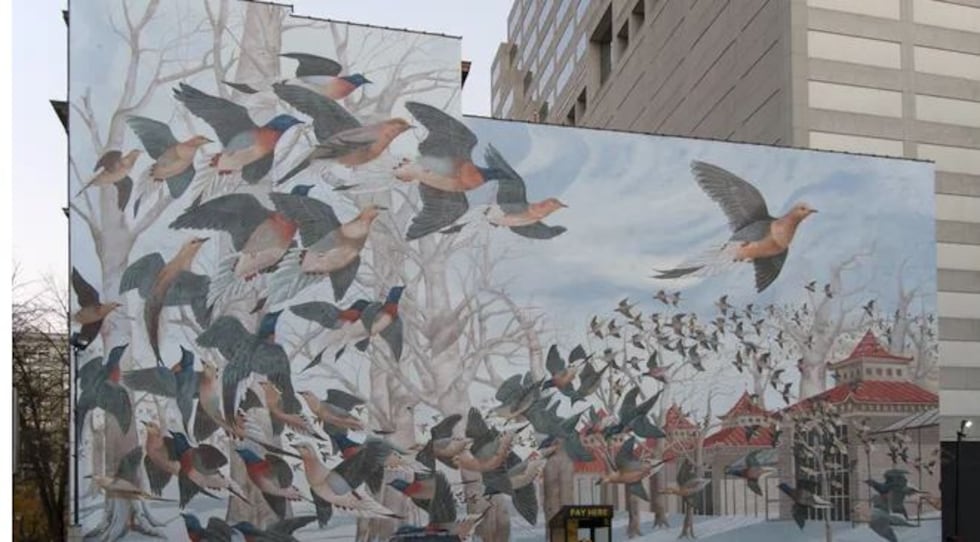
Cincinnatians may be most familiar with Ruthven’s three-story “Martha, the Last Passenger Pigeon” mural at the corner of Seventh and Vine streets.
The original painting was created to commemorate the 100th anniversary of Martha’s death, and the extinction of the species. ArtWorks headed the project and Ruthven climbed the scaffolding with student artists to create the tribute. The painting was a focal point during 2017′s Blink visual arts display downtown.
Numerous honors were bestowed upon Ruthven during his lifetime. Most notable was the 2004 National Medal of Arts he received from President George W. Bush. According to the citation, Ruthven was honored “for his impeccably accurate and unfailingly beautiful wildlife art, and in recognition of his contributions as an artist and naturalist to conserving our natural treasures.”
While internationally celebrated as an artist, Ruthven was locally known for his generosity. Proceeds from the sale of various artworks by the artist have benefited many groups and organizations, including the Mariemont Schools Foundation.
“John Ruthven and his late wife Judy, were treasures to all of us. It’s with a heavy heart we announce his passing, and the era of artistic vision and Grant history that now comes to a close,” states a post on the Facebook page for the U.S. Grant Boyhood Home & Schoolhouse Historic Sites in Georgetown, where Ruthven had lived for years.
The Ruthvens dedicated years of research to the study of Ulysses S. Grant and the preservation of Georgetown.
He was a member of Masterworks for Nature, a group of Cincinnati area artists dedicated to raising awareness and funds for conservation. The group partners with conservation and nature education organizations to hold exhibitions and raise money through sales and auction events. The group has raised over $1.3 million in gross receipts.
“The highest compliment that I can pay to John Ruthven is to call him the 20th century Audubon, a premier painter of wildlife that imbues his subjects with life and exquisite detail,” said Elizabeth Pierce, the Cincinnati Museum Center’s president and CEO, when the center announced in 2018 that it would publish Ruthven’s memoirs in 2019.
Ruthven has a long history with the center. He regularly visited the museum in the 1930s, then located in the Ohio Mechanics Institute on Central Parkway. At 10, he reportedly took his first specimen to the museum, a hummingbird he found dead. It was the first of hundreds of specimens from around the world he presented to the museum.
In 1972, he earned the distinction of being named the first Artist of the Year by Ducks Unlimited. Ruthven contributed paintings for prints that have raised nearly $2 million for the Memphis, Tennessee-based organization that works to protect and preserve wetlands in North America.
His painting of a cardinal for Ohio’s most popular license plate raised more than $5 million for the Ohio Division of Wildlife.
A childhood spent in nature
Ruthven’s love of the great outdoors dated back to his childhood in Walnut Hills where, in those days, hunting and fishing in the city were not unusual.
In an Enquirer article from 2014, Ruthven talked about riding a streetcar when he was about 10 years old with his shotgun to hunt rabbits. He would ride back home with a handful of rabbits.
During his childhood, he often slipped away to the banks of the Ohio River. There he would sit on the shore sketching and dreaming about the birds Audubon painted more than a century before.
The 90 year walk. A life well lived.
Art career followed WWII
The artist turned 18 in November of 1942 while a senior at Withrow High School. He was drafted that December to serve in World War II. He returned home in 1946 and entered the Cincinnati Art Academy.
Ruthven’s drawing of the boy featured on the first cans of Play-Doh kicked off his commercial art career.
His wildlife art career took off in 1960 after his Redhead Ducks painting won the Federal Duck Stamp competition. Federal Duck Stamps are conservation revenue stamps; 98 percent of the purchase price goes directly to help acquire and protect wetland habitat and purchase conservation easements for the National Wildlife Refuge system. More than 1.7 million copies of Ruthven’s $3 stamp were sold.
The quiet life in Georgetown
Ruthven spent more than half his life living on his 165-acre farmhouse, built in 1836, in Georgetown, Ohio. He and his second wife, Judy, purchased the property in 1964 for $19,000. The wooded property includes his home and studio plus plenty of trees, ponds and a running creek.
In Judy’s memory, Ruthven founded the Judy & John Ruthven Foundation, Inc. The foundation’s mission is to preserve history for future generations.
Ruthven’s wildlife paintings are on display in many museums including the Smithsonian; the Leigh Yawkey Woodson Museum in Wisconsin; the Roger Tory Peterson Insitute of Natural History in Jamestown, New York; and the Cincinnati Art Museum.
Original works have been unveiled around the world including in the White House, the Hermitage Museum in St. Petersburg, Russia, the Neil Armstrong Space Museum, and the Ohio State Capitol Rotunda.
Copyright 2020 WXIX. All rights reserved.